
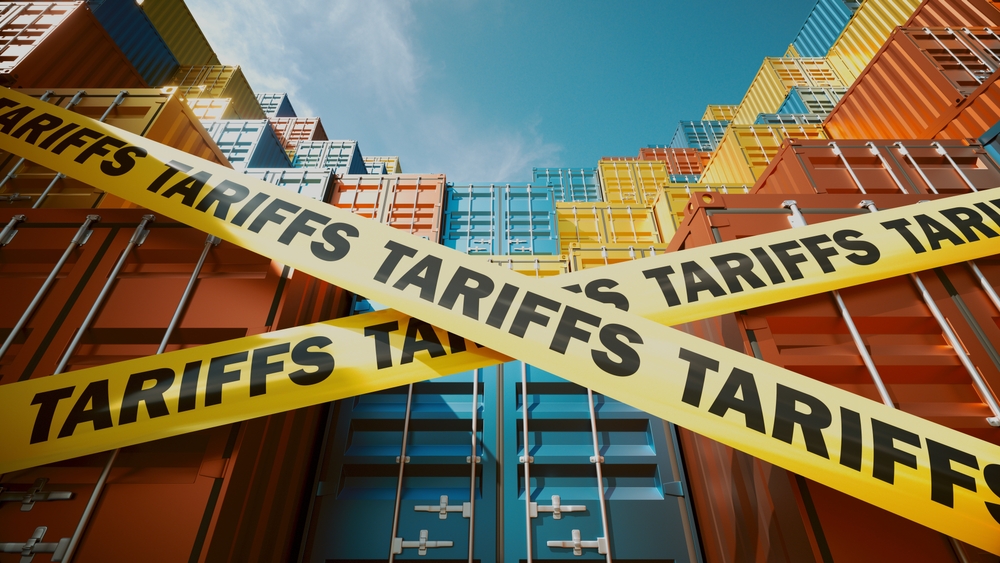
Oil tariffs are still creating cost uncertainty, but May’s bigger story is the way trade policy, crude volatility and freight pressure are all moving at once. For specialty oil buyers, the safest move is to review total delivered cost before the next order—not after the invoice arrives. Questions? Contact us.
Specialty oil buyers have had to follow a lot more than product pricing this year.
Temporary import duties remain under legal pressure. Refund timing is still uneven. Section 301 exclusions still matter for certain imported inputs. Energy markets are reacting sharply to every headline tied to Iran, the Strait of Hormuz, and possible peace talks.
Meanwhile, container and tanker markets are showing signs that disruption can return quickly, even when broad freight indices look manageable.
For manufacturers using white oils, base oils, Shell gas-to-liquids (GTL) isoparaffins, process oils or other specialty oils, the key question in May isn’t simply “Will oil tariffs go up or down?”
The better question is: What could change the true delivered cost of our next shipment?
That answer now depends on tariffs, legal rulings, refunds, Harmonized Tariff Schedule (HTS) classifications, crude balances, lane-specific freight conditions, product availability, and geopolitical risk.
Suzanne Kingsbury, Director of Quality
Tariff and Policy Changes to Watch in May
1. Section 122 Tariffs Were Dealt a Legal Blow, but They Haven’t Disappeared for Most Importers
The most important tariff development in early May came from the U.S. Court of International Trade. On May 7, the court ruled against the administration’s 10 percent temporary global tariffs under Section 122 of the Trade Act of 1974. The court found the tariffs were not justified under the statute.
But the ruling was narrow. It granted relief only to two importers and the State of Washington, rather than stopping collection for all importers nationwide. The administration is expected to appeal, and U.S. Trade Representative Jamieson Greer said the government expects to win that appeal.
For buyers, that means this is not a clean “tariffs are gone” moment. It’s a legal uncertainty moment.
If your company is paying duties tied to Section 122, talk with your customs broker or trade counsel before assuming the ruling changes your immediate cash position. The court decision may matter, but it may not change your entries, payment timing, or refund position right away.
2. Refunds Are Moving, but Cash Flow Timing Still Needs Careful Planning
Refund planning also remains complicated.
U.S. Customs and Border Protection (CBP) has created a process for International Emergency Economic Powers Act (IEEPA) duty refunds. CBP’s guidance says importers and authorized brokers should generally expect valid refunds within 60 to 90 days after acceptance.
That’s useful progress, but it isn’t the same as immediate relief.
For specialty oil buyers, the important point is cash flow. Refunds may eventually help offset prior tariff costs, but buyers still need to manage current duties, replacement tariffs, legal uncertainty, and possible delays. A refund that arrives later doesn’t prevent a landed-cost problem now.
3. Section 301 Exclusions Still Deserve a Fresh Review
Section 301 hasn’t gone away.
The Office of the United States Trade Representative (USTR) previously extended 178 China Section 301 exclusions through November 10, 2026.
For many specialty oil buyers, the exposure may not be the oil itself. It may come from imported packaging, additives, parts, equipment, intermediate goods, or other materials that affect the total cost of production.
(For example, costs on plastics-based products, such as IBC totes and plastic drums, have risen considerably.)
This is where HTS code review matters. Section 301 exclusion work is exact-match work. A close description isn’t enough. Buyers should confirm classifications, country of origin, supplier documentation, and whether any related inputs may still qualify for exclusions.
Oil Tariffs Aren’t the Only Cost Driver in May
Oil tariffs may be the headline, but they’re only one part of a broader pricing picture.
1. Iran and the Strait of Hormuz Are Still Driving Oil-Market Volatility
Energy markets remain highly sensitive to Iran-related headlines.
Reuters reported on May 4 that oil prices jumped after Iran tightened its grip on the Strait of Hormuz, with Brent crude rising 5.8 percent to $114.44 per barrel and West Texas Intermediate (WTI) crude climbing 4.4 percent to $106.42.
That kind of movement matters even when specialty oil pricing doesn’t move in lockstep with crude.
White oils, base oils, GTL isoparaffins, and other refined specialty oils have their own supply chains, specifications, and inventory realities. But sustained crude volatility can still affect feedstock expectations, refinery economics, freight costs, and surcharges.
2. Even Optimistic Peace Headlines Don’t Remove the Risk
Markets have also reacted sharply to reports of possible diplomatic progress.
The Guardian reported on May 6 that oil and gas prices fell on hopes of a U.S.-Iran peace deal and a potential reopening of the Strait of Hormuz. But the same report noted that uncertainty remained, with Iranian officials downplaying the proposed framework.
That’s why buyers should be careful about treating one calmer trading day as a supply-chain reset.
If a key shipping route has been disrupted, reopening it doesn’t instantly clear backlogs, normalize vessel availability, or reset supplier pricing. Even good news can take time to work through the system.
3. Venezuela Is Adding Supply, but It Doesn’t Eliminate Volatility
Venezuela remains another crude-market development to watch.
Venezuela’s oil exports rose 14 percent in April to 1.23 million barrels per day, the highest monthly level since 2018, with increased sales to the U.S., India, and Europe. On May 4, Italy’s energy group Eni restarted Venezuelan crude lifting in April as payment-in-kind for gas produced in the country.
For U.S. specialty oil buyers, this doesn’t mean Venezuelan supply solves the pricing volatility problem. It does mean crude flows are changing. Those changes can influence refinery decisions, global competition for barrels, and longer-term expectations around feedstock availability.
4. Qatar Supply of Shell GTL Remains Disrupted
Shell’s Pearl GTL in Qatar is a two-train facility of equal size that normally produces 140,000 barrels of oil equivalent per day from 1.6 billion cubic feet per day of feed gas.
The Strait of Hormuz blockage had already constrained exports before the March 18 attack, when one of the two trains was damaged. Production from the full facility was stopped to assess the damage. The initial assessment for full repair was around one year.
This means that a major GTL production asset is now exposed to two problems at once: physical repair downtime at one train and export constraints tied to the Strait of Hormuz.
If you depend on Shell GTL isoparaffins or GTL-based chemistry, now is a good time to review inventory, lead times, approved alternates, and supplier communication. Even when product is still available, a long repair window can tighten flexibility and make timing more important.
Shipping and Freight: May’s Risk Is More Lane-Specific Than Index-Level
Freight markets still don’t look like a full-scale crisis, but broad averages can hide the costs that matter most to a specific buyer.
1. Container Rates Are Moving Again
Drewry’s World Container Index increased 3 percent to $2,286 per 40-foot container on May 7 after three straight weekly declines, driven by higher freight rates on Transpacific and Asia-Europe trade lanes.
That’s not a panic number, but it’s a reminder that rates can turn quickly.
For specialty oil buyers, the issue isn’t only the index. It’s the lane, timing, carrier availability, surcharges, and whether a shipment is competing with higher-priority freight.
2. U.S. Container Imports Fell in April
U.S. container imports fell 5.5 percent in April, citing trade policy uncertainty and geopolitical risks. U.S. seaports handled more than 2.27 million twenty-foot equivalent units (TEUs), down 3.2 percent from March, while imports from China fell 15.3 percent year over year.
Lower import volume doesn’t automatically mean smoother logistics.
When trade flows shift, capacity can move, blank sailings can increase, and carriers can adjust pricing strategies. That can leave certain lanes tighter even while total volume appears softer.
3. Tanker and Energy Freight Risk Still Matters
Even if your specialty oil shipment isn’t moving as crude, tanker tightness and energy-route disruption can still ripple outward. (For example, we have seen significant delays lately in bulk chemical tankers, which we use for speciality oils.)
When buyers in Europe, Asia, or other markets look for replacement barrels, vessel demand can change quickly. That affects freight rates, insurance, routing, delivery timing, and the broader cost environment for energy-related materials.
For buyers, the practical question is simple: Does your supplier have enough logistics flexibility to keep product moving if a preferred route, terminal, or mode becomes more expensive?
Buyer Checklist: What Specialty Oil Buyers Should Review in May
May is a good time to check assumptions before they become cost surprises.
- Confirm whether any duties affecting your imported products or related inputs are tied to Section 122, Section 301, Section 232, or another authority.
- Don’t assume the May 7 trade court ruling eliminates duties for your company. Review your entries with a customs broker or trade counsel.
- Track IEEPA refund eligibility, but build cash-flow plans around the possibility that refunds may take 60 to 90 days after acceptance.
- Re-check HTS classifications, country-of-origin records, and supplier documentation for specialty oils and related imported materials.
- Review Section 301 exclusions for packaging, additives, equipment, parts, or other inputs that affect your total cost.
- Update landed-cost models using more than one scenario. A tariff-only model is too narrow in May.
- Ask logistics partners about lane-specific risk, including surcharges, blank sailings, tanker market pressure, routing changes, and insurance costs.
- Watch crude-market signals tied to Iran, Venezuela, and the Strait of Hormuz, but don’t overreact to one-day price swings.
- Build more timing flexibility into Q2 and Q3 orders where possible.
- Work with suppliers who can help you think through product availability, documentation, and delivery options together.
Don’t Let Oil Tariffs, Freight Shifts, and Market Volatility Control Your Next Order
Specialty oil buyers are working through a layered risk environment.
- Oil tariffs remain unsettled.
- Refunds are moving, but timing is still a concern.
- Section 301 exclusions still require careful HTS review.
- Crude markets are reacting to Iran, Venezuela, and changing trade flows.
- Freight costs can shift by lane before broad averages show a major problem.
At Renkert Oil, we help customers manage that complexity with dependable specialty oil supply, strong documentation support, and practical logistics guidance.
We can help you think through sourcing, order timing, product availability, and delivery options before volatility creates a preventable problem. As you plan your next purchase, we’ll help you look beyond tariff rates and focus on the true delivered cost of keeping your operation supplied.
Ready to talk through your next specialty oil order? Just reach out.
FAQs: May Oil Tariffs and Shipping Update
- Why are oil tariffs still important for specialty oil buyers?
Oil tariffs can affect landed costs, cash flow, and sourcing decisions, especially when they overlap with shifts in freight, crude volatility, and classification questions. - Are Section 122 tariffs still in effect?
Section 122 tariffs are facing legal challenges, but buyers should not assume they no longer apply to their imports without guidance from a customs broker or trade counsel. - What did the May 2026 trade court ruling mean for importers?
The ruling challenged the administration’s temporary global tariffs, but it did not automatically eliminate duties for all importers. The decision is expected to be appealed. - Can importers expect quick refunds for invalidated IEEPA duties?
Not necessarily. U.S. Customs and Border Protection (CBP) has a refund process, but accepted refunds may still take time to process. - Why do Section 301 exclusions still matter?
Section 301 exclusions can affect imported inputs such as packaging, additives, equipment, parts, or other materials that contribute to a manufacturer’s total cost. - What is an HTS code?
A Harmonized Tariff Schedule (HTS) code is the classification used to identify imported products for customs purposes. It helps determine applicable duties, exclusions, and documentation requirements. - Do crude oil prices directly control specialty oil pricing?
Not directly. Specialty oils have their own specifications, supply chains, and inventory dynamics, but sustained crude volatility can still affect feedstock costs, refinery behavior, and freight expectations. - Why does the Strait of Hormuz matter to U.S. specialty oil buyers?
The Strait of Hormuz is a major global oil route. Disruption there can affect crude flows, tanker availability, insurance costs, and broader energy-market pricing. - Can lower container import volume make shipping easier?
Not always. Lower total volume can still come with blank sailings, lane-specific capacity issues, changing carrier behavior, and unexpected surcharges. - How can Renkert Oil help buyers manage tariff and freight uncertainty?
We help customers think through supply timing, documentation, product availability, and logistics options so they can better manage the true delivered cost.