
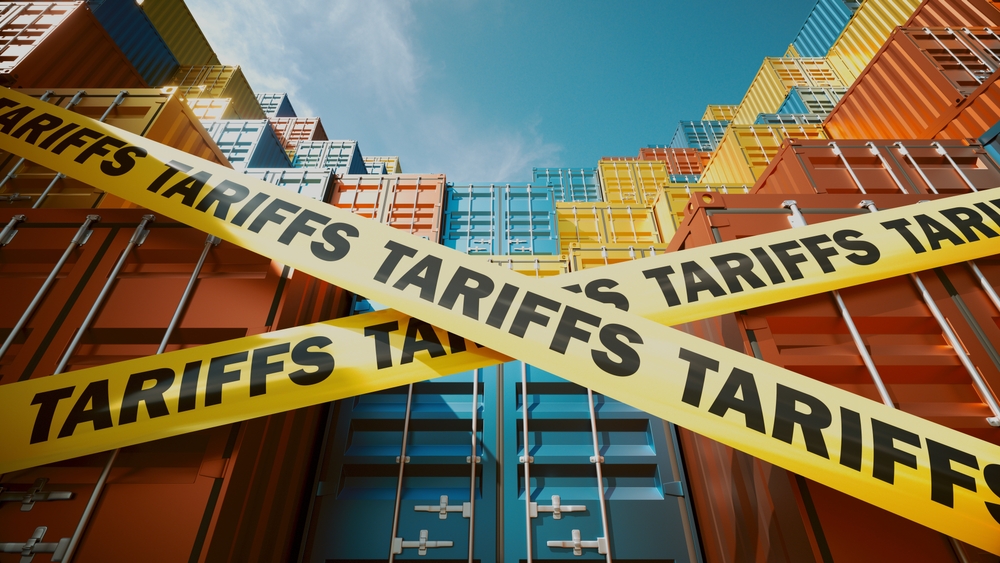
Oil tariffs are only one part of the June cost picture. Trade rulings, refund timing, crude volatility, container rate increases, and Middle East shipping risk are all affecting how specialty oil buyers should think about landed cost, lead times, and supplier flexibility. Questions? Contact us.
Specialty oil buyers are entering June with more moving parts than they had a month ago.
- Tariff questions are still not settled. Refunds are moving, but not instantly.
- Section 301 exclusions still need careful Harmonized Tariff Schedule (HTS) review.
- Container rates have climbed sharply on several major trade lanes.
- Crude and refined energy markets are still reacting to Iran, the Strait of Hormuz, Red Sea risk. (At the time of writing, we’re watching updates on the new U.S.-Iran peace agreement, which could bring new stability to global markets.)
- The long repair timeline at Shell’s Pearl gas-to-liquids (GTL) facility in Qatar will continue to bottleneck GTL product supply after the Strait is open, reducing capacity to half of what would be under optimal conditions.
Read on for more details and what to review this month to better understand your delivered costs.
Tariff and Policy Changes to Watch in June
1. Section 122 Tariffs Remain in Legal Limbo
The Section 122 tariff issue is still unresolved.
In May, the U.S. Court of International Trade ruled against the administration’s 10 percent global tariffs under Section 122 of the Trade Act of 1974. The court found that the tariff action exceeded the authority allowed under that statute, but relief was limited to the importer plaintiffs involved in the case.
For most importers, that means the ruling did not create a simple, across-the-board stop to tariff collection.
The practical takeaway for buyers is straightforward: don’t assume your company can stop paying Section 122 duties or claim refunds unless your customs broker or trade counsel confirms that your entries are affected.
June planning should treat Section 122 as a live issue, not a closed one. Buyers should continue tracking the appeal, reviewing affected entries, and building landed-cost scenarios that account for both continued collection and possible future relief.
2. IEEPA Refunds May Help, but Timing Still Matters
The International Emergency Economic Powers Act (IEEPA) tariff refund process is moving, but buyers should not confuse “eligible” with “immediate.”
U.S. Customs and Border Protection (CBP) guidance says valid IEEPA refunds will generally be issued within 60 to 90 days after acceptance, unless a compliance concern requires more review.
That helps importers plan, but it doesn’t eliminate cash-flow pressure.
For specialty oil buyers, this matters because replacement tariffs, current duties, freight increases, and supplier pricing may all hit before a refund arrives. If your business is counting on refund money to offset recent landed-cost increases, build a timing buffer into your planning.
This is also a good time to make sure the right people are aligned internally. Procurement, accounting, customs compliance, and finance should all understand which entries may qualify, which documents are needed, and when refunds are realistically expected.
3. Section 301 Exclusions Still Require Exact-Match Review
Section 301 remains important for buyers who import from China or rely on imported inputs tied to China-origin goods.
The Office of the United States Trade Representative (USTR) previously extended 178 Section 301 exclusions through November 10, 2026. These exclusions may not apply directly to the specialty oil itself, but they can still affect the cost of materials used around the product.
That may include packaging, equipment, parts, additives, intermediate materials, or other production inputs.
This is not an area for guesswork. Section 301 exclusion work depends on exact HTS classifications and specific product descriptions. A similar product is not automatically covered. A close match is not enough.
Buyers should review classifications, supplier documentation, country-of-origin records, and the cost impact of related inputs before assuming their landed-cost model is current.
Oil Tariffs Are Part of a Larger Cost Picture
1. Iran and the Strait of Hormuz Are Still Keeping Energy Markets on Edge
The Strait of Hormuz remains one of the biggest global energy risks to watch.
Oil markets are reacting to mixed signals: possible diplomatic progress, renewed hostilities, restricted traffic, proposals for transit fees, and continued uncertainty about how much oil and liquefied natural gas can move through the region.
Even when the market looks calmer on the surface, the underlying risk hasn’t gone away. Actual specialty oil costs are connected to refinery economics, feedstock expectations, freight routes, energy costs, and supplier inventory decisions that don’t necessarily make headlines.
A one-day price drop doesn’t mean the supply chain has normalized. A one-day price spike doesn’t mean every specialty oil price will move immediately, either. But sustained volatility can work its way into pricing, surcharges, lead times, and product availability.
Is It Time to Expand Your Credit Line?
This may be a good time to review working capital, not just product pricing. When petroleum-based products move higher, buyers may face larger invoices, higher dollar order sizes, and more cash tied up in inventory before finished goods are sold. That can create pressure even for companies with steady demand. This is not just a specialty oil issue. The Federal Reserve’s April 2026 Senior Loan Officer Opinion Survey reported an increase in borrower inquiries about new credit lines or increases in existing credit lines, which suggests many businesses are looking for more financial flexibility in a higher-cost, uncertain operating environment. For specialty oil buyers, the practical step is to make sure purchasing plans, credit availability, and cash-flow assumptions are aligned before a large order is needed.
2. Red Sea Risk Is Back in the Conversation
With Hormuz traffic still restricted, the Red Sea has become even more important as an alternate route for some energy flows. Recent Houthi threats against Israeli-linked shipping show how quickly one regional disruption can increase pressure on another route.
For buyers, the concern is not only whether a specific shipment moves through the Red Sea. It’s how carriers, insurers, and suppliers respond to risk.
If more vessels reroute, if insurance premiums rise, or if carriers reduce service in a contested area, those changes can affect schedule reliability and cost well beyond the immediate conflict zone.
3. Shell Pearl GTL in Qatar Remains a Supply Factor
Shell’s Pearl GTL facility in Qatar remains an important supply-chain issue for buyers who depend on Shell GTL isoparaffins or GTL-based chemistry.
Shell previously reported that Pearl GTL is a two-train facility of equal size that normally produces 140,000 barrels of oil equivalent per day from 1.6 billion cubic feet per day of feed gas.
One of the two trains was damaged in the March 18 attack, and production from the full facility was stopped for damage assessment. Shell has also indicated that returning the damaged train to service is expected to take around a year.
Of course, no product is currently moving through the Straight of Hormuz regardless. Assuming the Strait opens sooner than that, capacity will still be cut in half during the repair window, and buyers will be looking for alternatives.
If your formulation, specification, or customer approval depends on Shell GTL isoparaffins, now is the time to review inventory, lead times, minimum stock levels, and approved alternates. Waiting until a shortage appears in your purchasing cycle can leave fewer options.
Note: As of the time of writing, Renkert Oil still has a limited inventory of Shell GTL available.
Shipping and Freight: June Movement
1. Container Rates Jumped in Early June
Drewry’s World Container Index increased 23 percent to $3,433 per 40-foot container on June 4. Drewry tied the increase to higher rates on Transpacific and Asia-Europe trade routes as peak season began earlier than usual.
That’s a sharp move.
For specialty oil buyers, the main takeaway is that freight markets can change quickly, especially when trade policy uncertainty, geopolitical risk, and seasonal demand all hit at the same time.
Broad averages can also hide lane-specific pressure. A buyer may see manageable freight in one lane and a very different situation in another.
2. May Import Volumes Look Stronger, but the Trend Is Still Uneven
May import volume looked stronger than April, but buyers should be careful about reading that as a clean logistics recovery.
The National Retail Federation’s Global Port Tracker forecast June import volume at major U.S. container ports at 2.25 million TEUs (20-foot equivalent units), up 14.3 percent year over year.
That sounds like a positive shift, but the year-over-year comparison needs context. NRF noted that the May and June increases are partly tied to the sharp drop in imports that followed tariff announcements in April 2025.
In other words, June volume may look better on paper without changing the larger planning challenge. Import demand is still uneven. Buyers are still navigating tariff uncertainty, fuel costs, global economic pressure, and geopolitical risk.
Volume can shift quickly, and carrier behavior may shift with it. Even when national import numbers improve, you still need to watch lane-specific capacity, blank sailings, port conditions, surcharges, and carrier availability.
3. Tanker, Chemical, and Energy Freight Risk Still Matters
The importance of supply security is heightened at times like this. Tanker availability, war-risk insurance, port restrictions, and route changes can affect how energy-related products move around the world.
Bulk chemical tanker delays can also create real problems for specialty oil supply, especially when product is moving in large volumes or through a limited set of terminals.
It’s a good time to ask your suppliers whether:
- They have flexibility across terminals, modes, and logistics partners
- A product is available from domestic inventory with documentation ready
- An alternate delivery plan exists if the preferred route becomes more expensive or less reliable
Buyer Checklist: What Specialty Oil Buyers Should Review in June
June is a good time to pressure-test your next order before cost or timing changes show up late in the process.
- Confirm whether your imported products or related inputs are affected by Section 122, Section 301, Section 232, IEEPA, or another tariff authority.
- Don’t assume the Section 122 court ruling changes your immediate duty payments or refund position. Review entries with your customs broker or trade counsel.
- Track IEEPA refund eligibility, but plan around the possibility that refunds may take 60 to 90 days after acceptance.
- Re-check HTS classifications, country-of-origin records, and supplier documentation for specialty oils and related imported materials.
- Review Section 301 exclusions for packaging, additives, parts, equipment, and other inputs that may affect your total production cost.
- Update landed-cost models using several different scenarios (beyond just tariff vs. duty-free).
- Ask logistics partners about lane-specific freight pressure, blank sailings, surcharges, insurance costs, port constraints, and alternate routing.
- Watch crude and refined product signals tied to Iran, the Strait of Hormuz, the Red Sea, and Venezuela, but do not overreact to a single trading day.
- Review inventory and lead times for Shell GTL isoparaffins or GTL-dependent formulations.
- Confirm whether approved alternates exist before a supply issue becomes urgent.
- Build more timing flexibility into Q3 orders where possible.
- Work with suppliers who can help you evaluate product availability, documentation, tariff exposure, and delivery options together.
Renkert Oil Is Here to Help You Navigate Oil Tariffs, Shipping Costs, and More
None of these issues should cause our customers to panic. But they should encourage you to plan earlier, ask more questions, and avoid relying on last month’s assumptions.
Our team guides customers through the full supply picture, not just the product price. We support you with dependable specialty oil supply, documentation support, inventory planning, and practical logistics guidance.
If your team is reviewing Q3 orders, evaluating approved alternates, or trying to understand how tariffs and freight could affect your total delivered cost, we’re here to help you think it through before volatility creates a preventable problem.
Ready to talk through your next specialty oil order? Just reach out.
FAQs: Oil Tariffs and Shipping, June 2026
- Why are oil tariffs still a concern for specialty oil buyers?
Oil tariffs are still a concern because tariff policy, court rulings, refund timing, and trade classifications remain unsettled. Even when a tariff is under legal review, buyers may still need to account for duty payments, refund delays, and total landed-cost changes. - Do oil tariffs affect only imported specialty oils?
No. Oil tariffs may affect imported specialty oils directly, but they can also influence related costs such as packaging, additives, parts, equipment, freight, and other materials used in production or delivery. - Why does HTS classification matter for oil tariffs?
Harmonized Tariff Schedule (HTS) classification matters because tariff exposure and exclusion eligibility depend on exact product classification. A similar product description is not enough to confirm whether a duty, exclusion, or refund applies. - What are Section 301 tariff exclusions?
Section 301 tariff exclusions are specific product exclusions that may reduce or remove certain tariffs on eligible China-origin goods. These exclusions depend on exact product descriptions and HTS classifications. - Why do tariff refunds still require cash-flow planning?
Tariff refunds may take time to process, even when an importer is eligible. Buyers may still need to pay current duties, freight increases, supplier costs, and other charges before refund money arrives. - How can shipping risk affect specialty oil costs?
Shipping risk can affect specialty oil costs through higher freight rates, route changes, port delays, insurance costs, blank sailings, tanker pressure, and limited carrier availability. These issues can change the true delivered cost even when the base product price is stable. - Why do freight indexes not tell the whole story?
Freight indexes show broad market movement, but they may not reflect the specific lane, timing, carrier availability, surcharges, or port conditions affecting a buyer’s shipment. A buyer’s actual cost can change before broad averages show a major problem. - Why does Middle East shipping risk matter for specialty oil buyers?
Middle East shipping risk matters because routes such as the Strait of Hormuz and Red Sea are important to global energy movement. Disruption in these areas can affect crude markets, refined product flows, vessel availability, insurance costs, and supplier lead times. - Why should buyers review Shell GTL supply now?
Buyers who depend on Shell gas-to-liquids (GTL) isoparaffins should review supply because the Pearl GTL facility in Qatar has faced production disruption and a long repair window. Inventory, lead times, approved alternates, and supplier communication may become more important. - What should specialty oil buyers review before placing their next order?
Buyers should review tariff exposure, HTS codes, country of origin, refund eligibility, Section 301 exclusions, freight lanes, inventory needs, lead times, approved alternates, and total delivered cost before placing the next order.